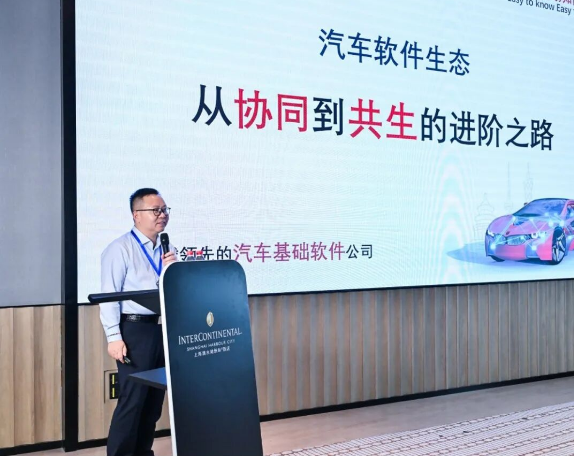
On November 7, 2025, the China Software High-Quality Development Conference was successfully held in Lingang. Shanghai ZC had the honor of serving as the organizer of the Lingang Automotive Software Development Forum, collaborating with ecosystem partners to create a thought-provoking feast of technology and ecology under the theme "Automotive Software Ecosystem: The Path from Collaboration to Symbiosis." At the forum, Mr. Chen Rongbo, Founder and General Manager of Shanghai ZC Technology Co., Ltd., delivered a speech titled "Automotive Software Ecosystem: The Path from Collaboration to Symbiosis."
At the beginning of his speech, Mr. Chen Rongbo highlighted the core issue facing the industry today: In the era of software-defined vehicles, how can China's automotive industry achieve the essential leap from "collaboration" to "symbiosis"? This is not only a technical challenge but also a strategic consideration involving industrial models, value logic, and ecosystem restructuring.
Industry Status: Software as the Core of Value, China as the Innovation Hub
Today, software has evolved from an automotive accessory to the core value of smart vehicles. Three major trends are profoundly reshaping the industry: software-defined vehicles moving from concept to practice, exponential growth in chip computing power, and the comprehensive electrification of powertrains. Against this backdrop, China, with its complete industrial chain, vast market, and dynamic innovation ecosystem, has become the main battlefield for global automotive innovation. Data shows that by 2025, China will launch 300 new vehicle models, 3.75 times the total of other regions. This not only reflects quantitative leadership but also demonstrates the systematic capabilities of China's automotive industry in R&D, manufacturing, and supply chain collaboration.
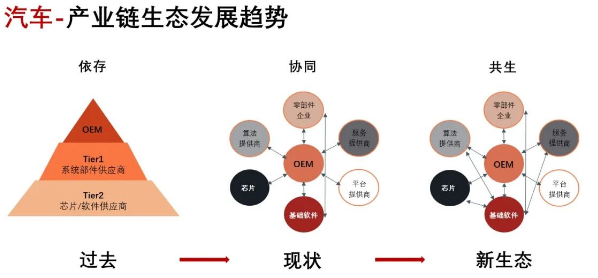
Ecological Evolution: A Three-Stage Leap from "Collaboration" to "Symbiosis"
China's automotive industry has evolved through three stages: Initially, an OEM-led linear model with relatively independent links; followed by a multi-stakeholder collaboration stage with preliminary ecosystem cooperation; and now, we are moving toward the third stage—a "symbiotic ecosystem" where vehicle manufacturers, chips, software, universities, and the government are deeply interconnected. The shift from "collaboration" to "symbiosis" is not merely a change in terminology but a fundamental restructuring of value distribution, capability building, and risk-sharing mechanisms, with its core lying in shared value, complementary capabilities, and shared risks.
Practical Challenges: Pain Points in the Industrial Chain
Addressing pain points such as the long development cycles of chip companies, software delays, and high cost pressures, ZC launched the "MuNiu" foundational software products and ecosystem support to accelerate controller mass production and chip adoption. Simultaneously, it provides the "WuKong" chip performance testing tool, enhancing chip functional evaluation efficiency through extensive test cases. Leveraging deep underlying experience, the company offers precise metrics for chip design and optimizes talent allocation, systematically reducing costs and improving efficiency to help chip companies overcome mass production and ecosystem bottlenecks.
For component companies struggling with foundational software platform development, diverse customer standards, and chip selection difficulties, ZC provides the "MuNiu" foundational software products and supporting services to quickly establish reliable software platforms, improving development efficiency and quality. The "XuanWu" testing tool efficiently meets diverse OEM standards, while the "WuKong" tool assists in chip functional testing.
For vehicle manufacturers facing challenges such as inconsistent component quality, high software change costs, complex chip selection, and profit pressures, ZC offers the "MuNiu" foundational software products and development services to enhance vehicle development efficiency and quality. The "XuanWu" testing tool automates the execution of highly reusable test cases to ensure vehicle quality, while the "WuKong" chip testing tool generates professional evaluation reports to assist in chip selection.
Solution: The Trinity of "Foundational Software + Toolchain + Services"
Addressing the pain points of the ecosystem industry, ZC has developed a trinity solution of "Foundational Software + Toolchain + Services."
At the foundational software level, the MuNiu platform is fully compatible with mainstream chips and has obtained dual certifications for ISO 26262 ASIL D and ASPICE CL3.
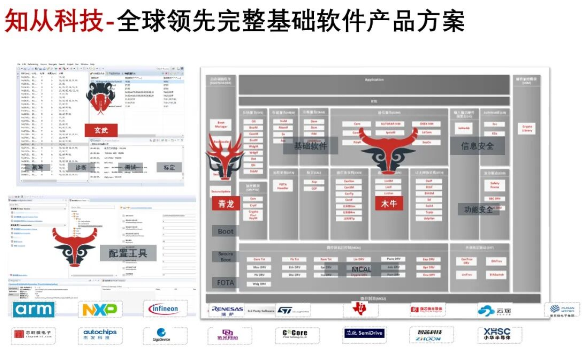
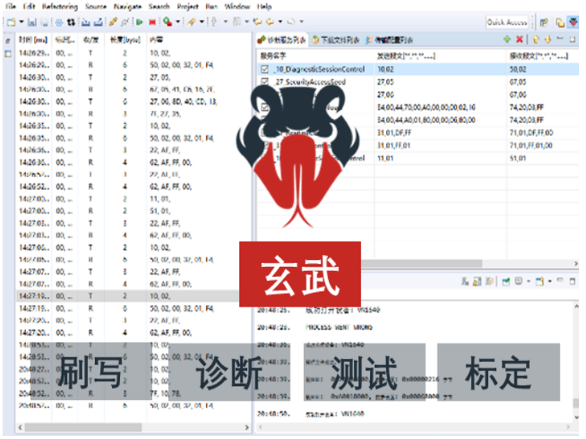
In terms of toolchain, "XuanWu" focuses on software testing and validation;
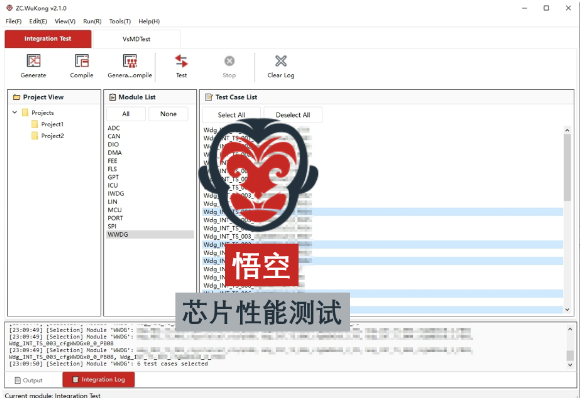
"WuKong" provides chip functional testing;
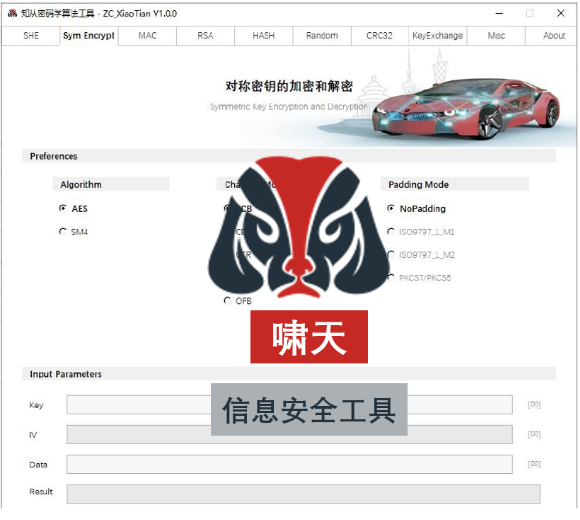
"XiaoTian" implements various encryption and decryption algorithms and is available for free to the entire industry.
At the service level, ZC offers end-to-end software development services to customers, from prototypes to mass production.
Practical Achievements: Initial Success in Ecosystem Building
Current practices have yielded tangible progress: Collaboration with leading chip companies has reduced the mass production cycle by 30%; trained talents have become the backbone of industrial innovation; and participation in ecosystem building has gradually released synergistic effects. These achievements demonstrate that ecosystem collaboration can significantly enhance industrial efficiency and quality.
Future Outlook: High-Quality Development as an Inevitable Direction
Looking ahead to the "15th Five-Year Plan," the nation emphasizes high-quality development and technological self-reliance, with security elevated to a strategic priority. This means the industry must shift from "competing on speed and cost" to "improving quality while achieving reasonable growth." In this process, foundational software is not merely a software component of controllers but also provides core support for industrial development and ecosystem collaboration.
With the mission of "Making Software More Reliable and Development More Efficient," ZC is committed to connecting the entire industrial chain, building an open and collaborative new ecosystem, and driving China's automotive industry from collaboration to symbiosis. The company looks forward to working with all stakeholders to build a healthy, resilient, and innovative new ecosystem for automotive software.