- ZC.MuNiu Basic Software OBD Product Manual
- ZC.MuNiu Basic Software Product Manual Based on Infineon TC264
- ZC.MuNiu OSEK Network Management Product Manual Based On NXP S32K344
- ZC.MuNiu Operating System Product Manual
- ZC.MuNiu Operating System SC4 Product Manual
- Porting from the Tricore to the ARM Architecture
- ZC.MuNiu OS Product Manual Based on ARM CORTEX R52+
- ZC.MuNiu Basic Software Product Manual Based on Infineon TC4X
- ZC.MuNiu Basic Software Product Manual Based on NXP S32K3
- ZC.MuNiu Basic Software Produt Manual Based on Infineon TLE989X
- ZC.MuNiu Product Manual Based on AFE TI BQ756506
- ZC.MuNiu Basic Software Product Manual Based on Renesas RH850U2A
- ZC.MuNiu AUTOSAR Software Platform Product Manual Based on Infineon TC264
- ZC.MuNiu Basic Sofatware Product Manual Based on AC781X
- ZC.MuNiu Operating System NgHypervisor Product Manual
- ZC.MuNiu Basic Software Product Manual Based on AC7840
- ZC.MuNiu Basic Software Product Manual Based on Renesas RH850F1KM
- Detailed Explanation of Infineon TC3XX_Cache and Overlay Functions
- ZC.MuNiu Basic Software Product Manual Based on ChipON KF32A
- ZC.MuNiu Basic Software for NXP S32K344
- ZC.MUNIU BASIC SOFTWARE PRODUCT MANUAL BASED ON TONGXIN MICRO THA6206
- ZC.MUNIU BASIC SOFTWARE PRODUCT MANUAL BASED ON FLAGCHIP FC7300
- ZC.MUNIU LIGHTWEIGHT BASIC SOFTWARE PRODUCT MANUAL
- ZC.MuNiu Basic Software Platform Product Manual
- ZC.MuNiu AUTOSAR Software Platform Product Manual Based on NXP S32K
- ZC.MuNiu AUTOSAR Software Platform Product Manual Based on NXP MPC5744P
- ZC.MuNiu AUTOSAR Software Platform Product Manual Based on Infineon TC275
- ZC.MuNiu SOC Product Manual
ZC.MuNiu lightweight basic software product provides an effective solution for resource-constrained automotive electronic controllers. This product complies with international standards such as AUTOSAR and features an upper-level configuration tool based on the AUTOSAR ARTOP architecture. It supports communication, diagnostic, and network management specifications for vehicle manufacturers including SAIC, FAW, Geely, GAC, Changan, GreatWall, and BAIC. The platform primarily includes: communication protocol stacks (CAN), diagnostic protocol stacks (UDS), network management (AUTOSAR), calibration protocol stacks (XCP/CCP), storage protocol stacks, and complex driver modules. It is complemented by ZC Bootloader update program and upper-level tools, enabling customization and further development according to specific customer project requirements. In addition to providing basic software products, ZC Technology also offers development services for the implementation of controller basic software functions.
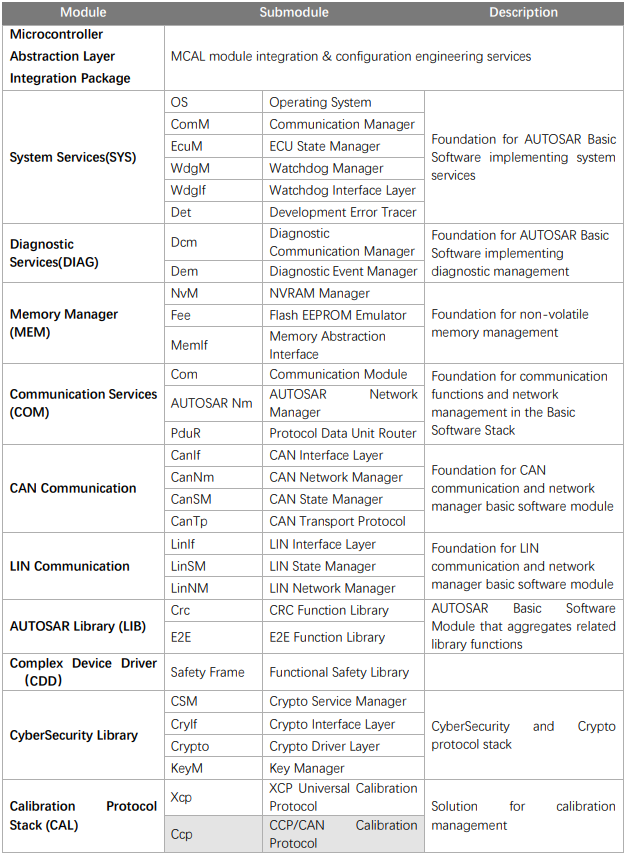
ZC.MuNiu lightweight AUTOSAR CP product is primarily designed for controllers such as fuel pumps and water pumps that demand high levels of integration, reliability, power efficiency, and cost-effectiveness. These controllers typically utilize small, highly integrated, automotive-grade chips, which are part of a low-memory chip platform, with Flash resources typically less than 512KB and RAM resources less than 32KB. Therefore, the lightweight basic software product ensures strict compliance with OEM specifications while eliminating a large number of redundant components from the traditional AUTOSAR architecture (see Figure 1), retaining only the necessary modules for the core functions of AUTOSAR (see Figure 2), thereby effectively reducing system complexity and resource consumption. Leveraging the powerful configuration capabilities of the ZC.MuNiu configuration tool, rapid configuration and adjustment of functional parameters for each module are achieved, significantly enhancing development efficiency and system operational flexibility on resource-constrained platforms.


Resource-constrained SoCs are being used in automotive electronics, industrial control and other fields. Taking the MOTIX TLE988x and TLE989x series launched by Infineon as an example, this series of chips have outstanding performance among similar products due to the significant advantages of higher performance and integration of more resources in a smaller area. However, the traditional AUTOSAR architecture contains a large number of modules and redundant features that make it difficult to adapt to such resource-constrained hardware platforms. In order to fully utilize the performance of these small chips while maintaining the integrity of AUTOSAR's basic functionality, ZC has launched the lightweight AUTOSAR CP base software product. Based on the in-depth trimming of the original full-volume AUTOSAR CP and the convenience of the ZC.MuNiu configuration tool, the product has successfully created a lightweight solution for the TLE989x series (e.g., TLE9891). At present, the solution has achieved mass production, providing the industry with a mature and reliable option to meet the demand for miniaturization.
In AUTOSAR architecture engineering, the COM (Communication) module is not only the core carrier for implementing automotive electronic communication functions, but also a key module in the entire CP product architecture. Below, we will focus on the COM module and briefly introduce its lightweight implementation approach in the entire product development process, from functional design to code trimming.
Ø Design lightweight feature list of COM module
In the AUTOSAR architecture, the COM (Communication) module is the core component of the communication protocol stack, and its core functions can be summarized in the following four points:
1. Signal routing and mapping: signal-level routing and gateway functions.
2、Communication protocol processing: PDU grouping/unpacking and management of communication attributes.
3、Communication scheduling and control: event or cycle triggered signaling.
4、Communication service support: providing standard interfaces for upper layer RTE, diagnostic communication, error handling, etc.
We have retained the basic functionality of the COM module, including maintaining signal sending and receiving, data interaction and CAN communication support. Non-essential redundant features such as complex gateway routing, support for dynamic signals, invalid signals, RC signals, and other minor scenarios are stripped out. For project OEM specifications, customised features are extended on top of the basic functionality, both with minimal code overhead (~1KB ROM) to achieve complete coverage of communication requirements.
Ø Tailor strategy for COM module
Traditional COM modules are designed with over 40 functional functions to accommodate diverse and complex scenarios, including operations such as protocol data unit (PDU) grouping, signal management, and dynamic signal handling. However, many of these features are tailored for less common scenarios, offering limited value in engineering applications while consuming excessive resources. This contradicts the core principles of lightweight AUTOSAR, which aims for streamlined and universally applicable high-frequency functionality. Therefore, through feature screening and interface integration, we retained over 10 key interfaces, covering core processes such as signal unpacking and repackaging, as well as the transmission and reception of protocol data units. This ensures the basic requirements for CAN communication and UDS diagnostics across the entire project.
PRODUCT FEATURES
Ø Code compliant with AUTOSAR 4.3.1 version
Ø Configuration tool based on ARTOP architecture, compatible with AUTOSAR 4.4.0 version
Ø Communication stack (CAN/LIN)
Ø Diagnostic stack (UDS)
Ø Network management stack (AUTOSAR)
Ø Calibration stack (XCP/CCP)
Ø Memory Stack
Ø Customised development of Functional Safety modules, CyberSecurity stack, Complex Device Drivers, etc.
Ø Engineering services
Ø … …

ZC.Muniu lightweight BSW PRODUCT’s Architecture
ZC.MUNIU Configuration Tool & Interface Demonstration
You can configure Can driver, Com, PduR, CanIf, Dcm, Dem, and CanTP modules of the lightweight AUTOSAR CP product with ZC.MuNiu Configuration Tool.

ZC.MUNIU CONFIGUE 
ZC.MUNIU CONFIGUE
In conclusion, compared with the traditional AUTOSAR architecture, the lightweight AUTOSAR CP products provide more targeted solutions for resource-constrained application scenarios, such as the TLE989x, by virtue of their streamlined modular design and highly efficient functional integration, which will drive their widespread deployment and continuous innovation in the market.
Click to download the product manual