- ZC.XuanWu Bootloader Upper Computer Product Manual(Requires approval before it can be trialed after application)
- ZC.MuNiu DEXT Studio Product Manual
- ZC.MuNiu Configuration Tool Product Manual
- ZC.XuanWu Program Update And Diagnostic Testing Tool Product Manual
- ZC.MuNiu MCAL Configuration Tool Product Manual Based on Flagchip FC7300
- ZC.MuNiu DBC Import and Configuration
- ZC Black Box Software Product Manual Based on Infineon TC277
- ZC.XUANWU XCP CALIBRATION UPPER COMPUTER PRODUCT MANUAL
- ZC.XUANWU CYBERSECURITY INTRODUCTION
- ZC.XIAOTIAN CYBERSECURITY TOOL(Can be downloaded and tried directly)
- ZC.XIAOTIAN CYBERSECURITY ALGORITHM TOOLS
- ZC.WUKONG MCAL TEST TOOL
- ZC.XUANWU COMPRESSED TRANSMISSION
- ZC.Xuanwu Calibration Upper Computer(Requires approval before it can be trialed after application)
- ZC.MuNiu MCAL Configuration Tool Product Manual Based on NXP S32K14x
ZC.XuanWu upper computer software is used to download application programs and data from the PC to the electronic controller. It supports UDS on CAN, UDS on Eth, UDS on K-Line, and UDS on LIN protocols. It offers customized integration of customer-specific protocols and is widely used in the development, testing, and after-sales service stages of electronic controller products.
ZC.XuanWu program refresh and diagnostic testing tools can be applied in various application scenarios for OEMs and Tier 1 suppliers. Users can conveniently perform program flashing work in laboratories, test vehicles, and actual vehicles.
ZC.XuanWu upper computer software is currently used for program flashing of various electronic controllers:
Ø Body Control Module (BCM)
Ø Air Conditioning Controller
Ø DC/DC Converter
Ø Electric Power Steering Controller
Ø Engine Management System (EMS)
Ø Transmission Control Module (TCM)
Ø Battery Management System (BMS)
Ø Vehicle Control Unit (VCU)
Ø Motor Control Unit (MCU)
Ø Electric Power Steering System (EPS)
Ø Anti-lock Braking System (ABS)
Ø Electronic Stability Program (ESP)
Ø Active Collision Avoidance System (ACC)
Ø Traction Control System (TCS)
Ø Advanced Driver Assistance Systems Controller
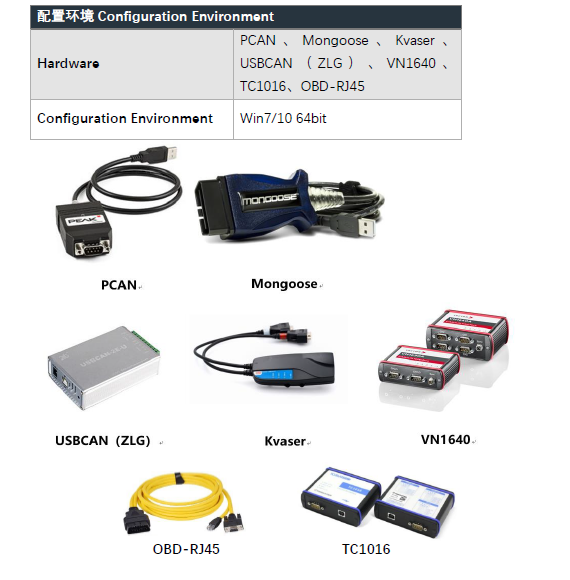
The ZC.XuanWu host computer supports the following devices:
1.INFORMATION SECURITY FEATURES INTRODUCTION
Against the backdrop of the rapid development of intelligent and connected vehicles, in-vehicle electronic systems are becoming increasingly complex, and the amount of data generated by vehicles is growing exponentially. Real-time processing and transmission of massive amounts of data pose severe challenges to vehicle network bandwidth and storage resources. Against this background, data compression and transmission technology has become one of the key means to ensure efficient and reliable communication. In addition, in the field of automotive information security, compression and transmission technology and encryption technology have formed a collaborative protection system. Usually, a processing flow of "compress first, then encrypt" is adopted, which not only reduces the amount of data to be encrypted, improves the efficiency of encryption operations, but also enhances overall security—because the redundancy of compressed data is reduced, statistical characteristics are weakened, making cryptanalysis attacks more difficult.
Compression transmission technology, especially the LZSS algorithm, plays an indispensable role in data processing and communication in the automotive industry. Compression transmission technology can significantly reduce the amount of transmitted data by eliminating data redundancy while ensuring information integrity, thereby saving bandwidth resources, improving transmission efficiency, reducing system power consumption, enhancing system response real-time performance, and collaborating with information security mechanisms to provide key technical support for building an efficient, reliable, and secure intelligent transportation ecosystem.
1.1Introduction to the LZSS Algorithm
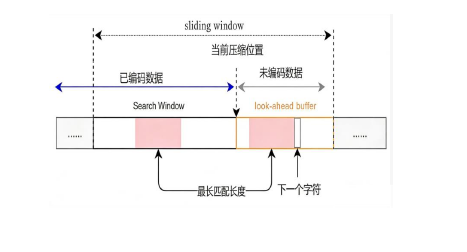
LZSS is a lossless data compression algorithm based on sliding window dictionary encoding, optimized from the LZ77 algorithm. Its core idea is to compress and encode data by searching for and referencing repeated patterns in previously processed data.
The algorithm maintains a fixed-size sliding window, which consists of two parts: the search buffer stores recently encoded data, and the look-ahead buffer caches data to be encoded. During the compression process, the algorithm continuously searches for the longest matching substring in the look-ahead buffer within the search buffer. When the match length exceeds a preset threshold, a position-length pair (usually containing information about the match start position and length) is used to replace the original data; otherwise, the original characters are directly output. This dynamic replacement mechanism can efficiently eliminate data redundancy and achieve lossless compression, as shown below:
1.2Compressed Transmission Scenarios
In the UDS protocol (ISO 14229-1), the application of compressed transmission technology provides an effective solution for improving the efficiency of flashing. By modifying the relevant configuration of the Request Download service (SID=0x34), it is possible to define the data format for compressed and encrypted flashing. The flashing tool can inform the ECU whether the data to be transmitted has been compressed, thereby significantly reducing the actual amount of data transmitted and shortening the flashing time while ensuring data integrity.
The format of Service 34 message defined in ISO 14229-1 is shown in the figure below:
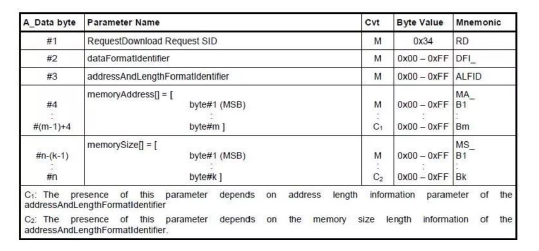
In the specific implementation, the high four bits of the dataFormatIdentifier parameter are used to indicate the compression method. When compressed transmission is enabled, the vehicle manufacturer needs to clarify the meaning represented by the memorySize parameter in the protocol - whether it refers to the size of the compressed data or the size of the original data. This design choice directly affects the logical implementation of the internal Bootloader of the ECU: if memorySize represents the compressed size, the ECU directly performs byte count comparison when receiving data and implements decompression operations before writing to Flash; if it represents the original data size, the ECU needs to calculate the cumulative amount of decompressed data in real time and perform a final verification with this parameter.
This flexible design enables compressed transmission to adapt to the resource constraints of different ECUs while ensuring the integrity and reliability of data transmission, providing key technical support for the efficient software updates of intelligent connected vehicles.
2.XUANWU INFORMATION COMPRESSED TRANSMISSION
2.1Compressed Transmission
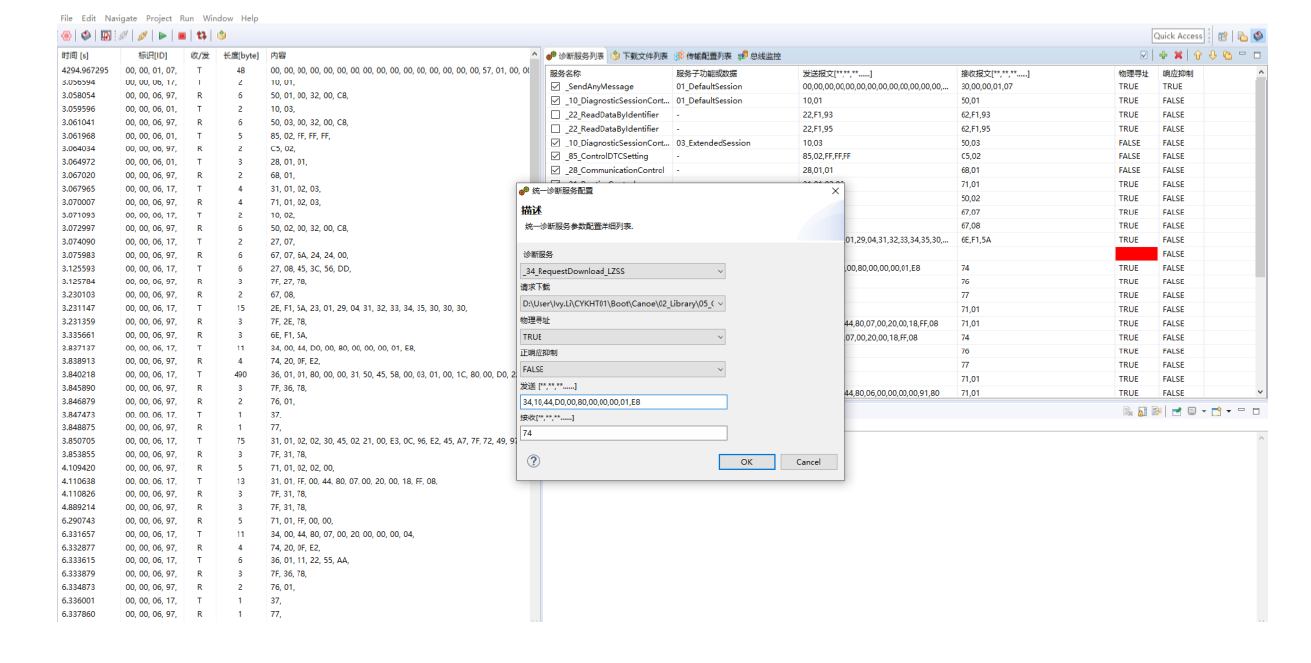
ZC.XuanWu supports users to send single or multiple diagnostic messages to the ECU. For compressed transmission, Xuanwu supports configuration when creating a new UDS 0x34 service. Select _34_RequestDownload_LZSS, click Path-File to select a file, compress the configured flashing file using the LZSS algorithm, and perform the flashing operation through the diagnostic service.
ZC.XuanWu's default dataFormatIdentifier is 0x10, and users need to configure the starting address and size of the flash file.
Against the backdrop of increasingly complex ECU software, efficient and reliable software updating capabilities have become a critical requirement for automotive electronic systems. Xuanwu, as a highly adaptable flashing tool, achieves compatibility with various Bootloader specifications through customizable configurations. For low-speed bus scenarios such as CAN, the tool supports compressed transmission to enhance flashing efficiency for large data volumes. Simultaneously, to meet the security requirements across R&D, production, and after-sales stages, it also enables encryption of flashing files to prevent data tampering and unauthorized usage. Xuanwu not only ensures the stability and security of data transmission but also provides flexible functional support tailored to actual flashing specifications, establishing itself as a vital tool for managing the entire vehicle software lifecycle.
Click to download the product manual