- ZC.QingLong Secureboot Based On Infineon TC2XX
- ZC.QingLong SPI OTA Product Manual Based On Infineon TC397
- ZC.QingLong SecureBoot Product Manual Based on NXP S32K3 For CHERY QSQR
- ZC.QingLong BootLoader Product Manual Based on NXP S32K3
- ZC.QingLong FOTA Solution
- ZC.QingLong BootLoader
- ZC.QingLong BootLoader Product Manual Based on NXP KW45
- ZC.QingLong SecureBoot Product Manual Based on Infineon TC377
- ZC.QingLong FOTA Product Manual Based on Infineon TC387
- Introduction to ZC.QingLong Ethernet Flashing Based on RH850U2A
- ZC.Qinglong Ethernet BootLoader Product Manual Based on RENESAS RH850U2A
- ZC.QingLong SecureBoot Product for NXP S32K344
- ZC.QINGLONG FOTA PRODUCT MANUAL BASED ON INFINEON TLE9893
- ZC.QINGLONG SECUREBOOT PRODUCT MANUAL BASED ON INFINEON TC2XX FOR FAW-VW
- ZC.QINGLONG YUNTU YTM32B1HA0X SECUREBOOT INTRODUCTION
- ZC.QINGLONG UART BOOTLOADER PRODUCT MANUAL BASED ON TMS570
- ZC.QINGLONG PIPELINE PROGRAM SOLUTION INTRODUCTION
- ZC.QingLong BootLoader Based on Infineon TC213 SMTC
- ZC.QingLong BootLoader Product Manual Based on STSPC58NN for GEELY GEEA2.0
- ZC.Qinglong Bootloader Product Manual Based On NXP NCJ29D5
- ZC.QingLong FOTA Product Manual Based on Infineon TC3xx
- ZC.QingLong FOTA
- ZC.QingLong Secureboot Based on NXP S32K1XX
ZC.QingLong BootLoader is a program flashing software (BootLoader) independently developed by ZC Technology. For controllers using the ZC.QingLong BootLoader, the update function of application programs can be achieved through communication methods such as CAN, LIN, SPI, UART, and Ethernet. The ZC.QingLong BootLoader already supports chips from multiple manufacturers including NXP, Infineon, Renesas, and ST. Moreover, it is compatible with the program flashing specifications of multiple vehicle manufacturers and can provide customized development services.
Based on the ZC.Qinglong BootLoader, the ZC.Qinglong Ethernet OTA, which is based on the Renesas RH850U2A platform, combines the Ethernet diagnostic protocol with the DOIP function to achieve the Ethernet flashing function. The controller can execute OTA flashing through Ethernet communication. On this basis, it supports and adapts to information security functions such as secure boot and secure flashing, as well as OTA functions such as AB partition backup and version rollback, improving the efficiency and security of program flashing. The ZC.Qinglong Ethernet OTA also supports the OTA specifications of multiple vehicle manufacturers and provides customized development services.
The ZC.Qinglong Ethernet OTA can be applied to the program flashing function of controllers using the RH850U2A series of chips. The supported controllers include:
Ø Body Systems Vehicle
Domain controllers, zone controllers, gateways, etc.
Ø Power Systems
Battery management systems, etc
Ø Chassis Systems
Electric power steering systems, anti-lock braking systems, electronic stability systems, etc
Intelligent and connected vehicles are the future direction of the automotive industry. The rapid development of smart cars has changed the value of cars. With the rise of user experience needs, system software has become increasingly important, and the trend of software-defined vehicles has become irreversible.
The core idea of Software Defined Vehicles (SDV) is that the future of cars will be determined by software technology centered on artificial intelligence, rather than the size of the car's horsepower, whether it has genuine leather seats, or the quality of its mechanical performance. This will become a common development trend in the automotive industry. The industrial structure of the automotive industry is following the development path of the computer and mobile phone industries, and the standard for measuring the quality of cars will shift from the "hardware" level to the level of intelligence and the quality of software services.
In the process of automotive intelligence development, although the importance and proportion of software continue to increase, the research and development cycle of the whole vehicle is invisibly shortened, so the risk of car recalls caused by software vulnerabilities continues to rise. At present, the total code amount of high-end cars has exceeded 100 million lines. Even if controlled according to the highest software standard of CMMI (Capability Maturity Model Integration) level 5, the code defect rate is still 0.32‰, and the scale of potential problems is not to be underestimated. Recall events require car manufacturers to pay huge direct and indirect costs.
For industries in development, facing the major trend of the development of smart cars, system update functions similar to those of Tesla will inevitably become the premise and foundation for the sustainable development of the industry. FOTA (Firmware Over-The-Air) has thus become one of the best solutions for addressing software vulnerabilities and upgrading smart car components.
FOTA wireless upgrades refer to providing firmware upgrade services for terminal devices with networking capabilities through the cloud. Users use the network to obtain smart terminal system upgrade packages on demand and in an easy-to-expand manner, and upgrade through FOTA to complete system repairs and optimizations. Car manufacturers and suppliers can quickly and conveniently achieve iterations of car ECUs, system versions, etc., through professional FOTA upgrade plans, ensuring system security and rapid upgrades, allowing users to experience new functions without replacing hardware equipment.
Ethernet typically offers a high data transfer rate, enabling the rapid transmission of large volumes of data. This is crucial for relatively large software or firmware files during OTA upgrades, as it can significantly reduce the upgrade time and minimize the user's waiting period. By implementing the DoIP for efficient data transfer and a flexible network architecture, it provides reliable support for modern vehicle diagnostics and offers a reliable remote upgrade solution to meet OTA upgrade requirements. This substantially cuts down the costs associated with vehicle updates and recalls.
At present, FOTA has gradually been recognized and has developed into a new trend of the Internet of Vehicles that affects the decisions of OEMs (Original Equipment Manufacturers) and TSPs (Telematics Service Providers). It is also one of the innovative attempts and trends for car manufacturers to improve user experience.
Ø Uses Ethernet DoIP protocol for data transmission, compliant with the ISO 14229 standard.
Ø Adaptable to the program update specifications of various car manufacturers.
Ø Supports multiple encryption mechanisms to ensure the security and reliability of data.
Ø Offers update capabilities for both applications and data.
Ø Supports AB partition SWAP functionality to ensure the integrity of data during the upgrade process.
Ø Features safe and stable upgrade processes with mechanisms such as breakpoint resumption, intelligent restoration, and traceability.
Ø Supports differential restoration technology, which can speed up the upgrade process by 90% compared to standard upgrades.
Ø Supports full package upgrades for enhanced security.
Ø Compatible with ZC.Xuanwu program update tools, providing a comprehensive solution for program updates.
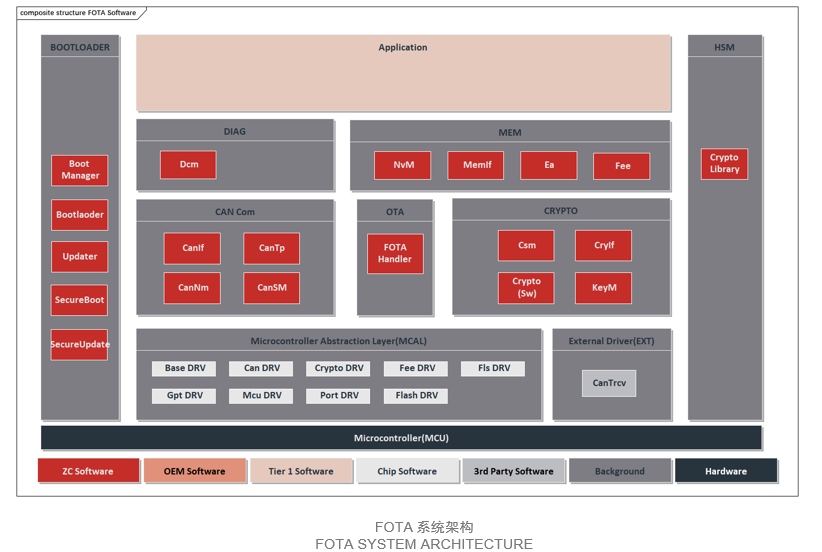
The Qinglong Ethernet FOTA system architecture supports the FOTA function in Ethernet communication scenarios. It realizes the UDS diagnostic flashing for Ethernet communication through the TCP/IP, DoIP, SoAd, and Dcm modules, and meets the Cybersecurity requirements of various OEM specifications by adapting to the Crypto Library. The following are the function descriptions of each module:
Ø Bootloader
The BootManager module provides FOTA startup management functions and supports the adaptation of hardware and software SecureBoot functions. It stores the expected MAC values of the Bootloader and Application through programming and flashing. During the startup phase, SecureBoot performs software integrity verification by calculating and comparing the MACs of the Bootloader and Application to ensure software security requirements.
Ø Ethernet Com
The DoIP module realizes the Ethernet communication sending and receiving functions based on the TCP/IP protocol, meeting the definition of the ISO 13400 standard. It implements the UDS flashing process through vehicle identification, routing activation, and diagnostic message functions, thereby achieving the Ethernet OTA function.
Ø Crypto、HSM
The Ethernet OTA supports the adaptation of the Muniu encryption library functions. It combines asymmetric encryption algorithms with other encryption algorithms to achieve the secure flashing function. It adapts to the certificate authentication function to meet the security diagnostic requirements and adapts to the HSM to improve the stability and verification speed of the Cybersecurity function.
Communication Sequence
The external diagnostic device and the in - vehicle DoIP entity complete the communication connection through vehicle identification, connection establishment, and routing activation, and execute the diagnostic flashing function of Ethernet OTA by sending diagnostic services.
The process of establishing communication between the external diagnostic device and the in - vehicle DoIP entity is shown in the following figure.
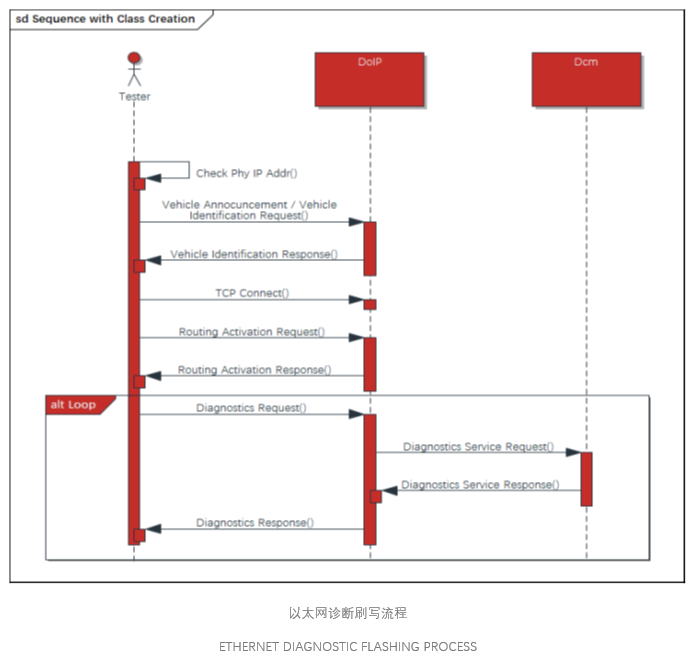
The purpose of the vehicle discovery process is to inform other DoIP nodes within the current local area network of the DoIP attributes of a node. Other DoIP nodes can decide whether to establish a connection and communicate with it according to their own business requirements.
a) After powering on, the Client actively sends a Vehicle Announcement Message / Vehicle Identification Request in a broadcast manner, carrying information such as the logical address, VIN (Vehicle Identification Number), and EID (Entity ID) in the message.
b) The Server that receives this message replies with a Vehicle Identification Response message in unicast form, which carries information such as the logical address, VIN, and EID.
After the Client and the Server complete the vehicle identification, they conduct UDS communication by establishing a TCP connection.
a) The Client takes the initiative to establish a TCP connection with the Server.
b) The Client sends a Routing Activation Request message to request the activation of the route. The Server agrees or rejects the activation request according to the actual situation, and notifies the Client of the activation result by sending a Routing Activation Response message.
After the route activation is completed, the host computer sends a diagnostic flashing request through the DoIP protocol and executes the OTA update function according to the flashing process.
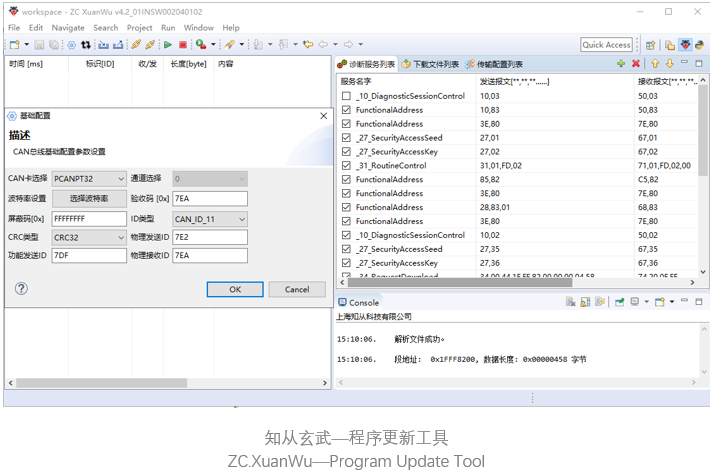
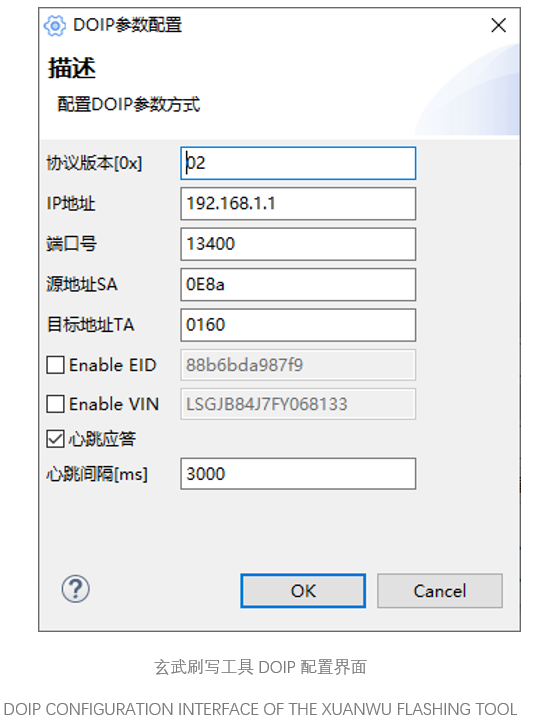
The ZC.Xuanwu Flashing Tool already supports the Ethernet flashing function based on the DoIP communication protocol. Before using the ZC.Xuanwu Flashing Tool for flashing, it is necessary to configure the communication interface type, communication IP address, port number, source address (SA), destination address (TA), etc.
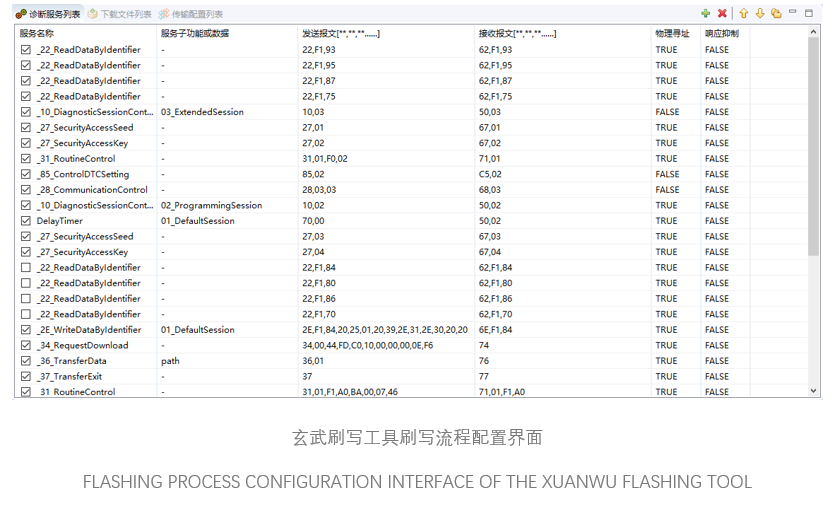
Before performing the flashing operation, you need to import a preset XML file to load the flashing process corresponding to the OEM's flashing specifications, or configure the flashing process services by yourself.
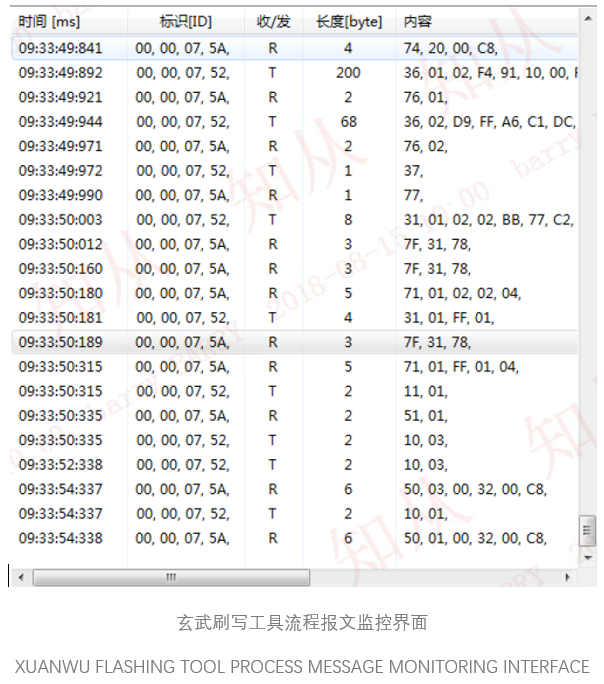
After the flashing process starts, users can observe the flashing progress and any errors that occur during the flashing process through the process message monitoring interface.

Click to download the product manual