- ZC.QingLong Secureboot Based On Infineon TC2XX
- ZC.QingLong SPI OTA Product Manual Based On Infineon TC397
- ZC.QingLong SecureBoot Product Manual Based on NXP S32K3 For CHERY QSQR
- ZC.QingLong BootLoader Product Manual Based on NXP S32K3
- ZC.QingLong FOTA Solution
- ZC.QingLong BootLoader
- ZC.QingLong BootLoader Product Manual Based on NXP KW45
- ZC.QingLong SecureBoot Product Manual Based on Infineon TC377
- ZC.QingLong FOTA Product Manual Based on Infineon TC387
- Introduction to ZC.QingLong Ethernet Flashing Based on RH850U2A
- ZC.Qinglong Ethernet BootLoader Product Manual Based on RENESAS RH850U2A
- ZC.QingLong SecureBoot Product for NXP S32K344
- ZC.QINGLONG FOTA PRODUCT MANUAL BASED ON INFINEON TLE9893
- ZC.QINGLONG SECUREBOOT PRODUCT MANUAL BASED ON INFINEON TC2XX FOR FAW-VW
- ZC.QINGLONG YUNTU YTM32B1HA0X SECUREBOOT INTRODUCTION
- ZC.QINGLONG UART BOOTLOADER PRODUCT MANUAL BASED ON TMS570
- ZC.QINGLONG PIPELINE PROGRAM SOLUTION INTRODUCTION
- ZC.QingLong BootLoader Based on Infineon TC213 SMTC
- ZC.QingLong BootLoader Product Manual Based on STSPC58NN for GEELY GEEA2.0
- ZC.Qinglong Bootloader Product Manual Based On NXP NCJ29D5
- ZC.QingLong FOTA Product Manual Based on Infineon TC3xx
- ZC.QingLong FOTA
- ZC.QingLong Secureboot Based on NXP S32K1XX
Intelligentization and connectivity are the future development directions of the automotive industry. The rapid development of smart cars has changed the value of the car. With the rising demand for user experience, system software has become increasingly important, and the trend of software-defined vehicles has become irreversible.
The core idea of Software Defined Vehicles (SDV) is that the future of cars will be determined by software technology centered on artificial intelligence, rather than the size of the car's horsepower, whether it has genuine leather seats, or the quality of its mechanical performance. This will also become a common development trend in the automotive industry. The industrial structure of the automotive industry is re-following the development path of the computer and mobile phone industries. In the future, the standard for measuring the quality of cars will shift from "hardware" level to the level of intelligence and the quality of software services.
In the process of automotive intelligence development, although the importance and proportion of software continue to increase, the R&D cycle of the whole vehicle is invisibly shortened, so the risk of car recalls caused by software vulnerabilities continues to rise. At present, the code volume of high-end cars has already broken through 100 million lines. Even if controlled according to the highest software standard of CMMI (Capability Maturity Model Integration) Level 5, the code defect rate is still 0.32 ‰, and the scale of potential problems is not to be underestimated. Recall events require car manufacturers to pay huge direct and indirect costs.
For the industry in development, facing the big trend of the development of smart cars, system update functions like Tesla will inevitably become the premise and foundation for the sustainable development of the industry, and FOTA (Firmware Over-The-Air) has become one of the best solutions for solving software vulnerabilities and upgrading smart car accessories.
FOTA wireless upgrade refers to providing firmware upgrade services for terminal devices with networking capabilities through the cloud. Users use the network to obtain smart terminal system upgrade packages on demand and in an easy-to-expand manner, and upgrade through FOTA to complete system repair and optimization. Car manufacturers and suppliers can quickly and conveniently realize the iteration of car ECU, system version, etc., through professional FOTA upgrade solutions, ensuring system security and rapid upgrade, allowing users to experience new functions without replacing hardware equipment.
At present, FOTA has gradually been recognized and has developed into a new trend of the car networking that affects the decision-making of OEM (Original Equipment Manufacturer) and TSP (Telematics Service Provider), and it is also one of the innovative attempts and trends for car manufacturers to improve user experience.
1.platform support
2.feature description
2.1Product Features
Ø Utilizes the DoIP protocol for data transmission, compliant with the ISO13400 standard;
Ø Suitable for the program update specifications of multiple vehicle manufacturers;
Ø Supports chips from multiple chip manufacturers.
Ø Supports multiple encryption mechanisms to ensure the security and reliability of data;
Ø Supports the update functionality for applications and data;
Ø Supports resumable transfers, intelligent rollback, and traceable security mechanisms to ensure a safe and stable upgrade process.
Ø Supports differential rollback technology, which speeds up the upgrade time by 90% compared to conventional upgrades;
Ø Supports full package upgrades, providing more security assurance;
Ø Compatible with ZC.Xuanwu program update tools, offering a complete program update solution.
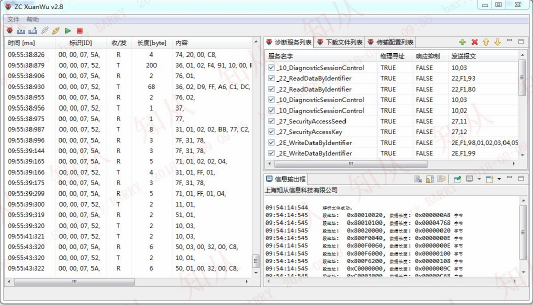
ZC. Xuanwu - Program Update Tool
3.Deployment Modes
ZC.Qinglong FOTA supports three deployment methods, which can provide users with different implementation schemes.。
Ø Hardware AB Partition Scheme:
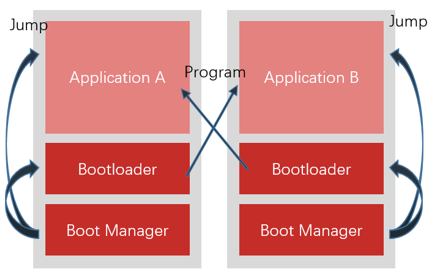
Hardware AB Partition Scheme
As shown in Figure 5-3, the Flash area is divided into Area A and Area B, with only one active area and one inactive area. The active area is used to run the App software, while the inactive area is used for the Bootloader to download new versions of the App software, and the active and inactive areas can be freely switched through hardware functionality to run the corresponding area software.
Advantages of the scheme:
l Application A and Application B do not interfere with each other and can run independently.
l Rolling back is convenient; simply switch the active area and reset to complete the rollback.
Disadvantages of the scheme:
l Requires the chip to support address mapping functionality.
l Address allocation is limited by the address mapping functionality.
Ø Software AB Partition Scheme
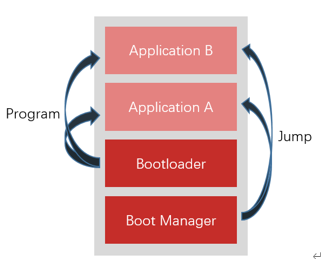
As shown in Figure 5-4, the Application area is divided into Area A and Area B, with only one active area and one inactive area. The active area is used to run the App software, while the inactive area is used for the Bootloader to download new versions of the App software, and the active and inactive areas can be freely switched. The Boot Manager will determine which active area to jump to at startup
Advantages of the scheme:
l Application A and Application B do not interfere with each other and can run independently.
l Rolling back is convenient; simply switch the active area and reset to complete the rollback.
l No hardware support for address mapping functionality is required.
Disadvantages of the scheme:
l The address allocation for partitions A and B is inconsistent, requiring the use of two sets of address allocations to generate Application software.
Ø Software Backup Partition Scheme:
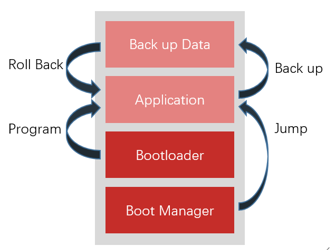
Software Backup Partition Scheme
As shown in Figure 5-5, the Application area is divided into a running area and a backup area. The running area is used to store the running Application, and the backup area is used to store the Application that was running before the update. When the App software needs to be rolled back, the Bootloader completes the rollback by downloading the data from the Back up Data area back into the Application.
Advantages of the scheme:
l The Application running address is fixed.
l The size of the Back up Data area can be reduced through compression algorithms.
Disadvantages of the scheme:
l Rolling back requires a certain amount of time.
l Only the Application can be rolled back to an older version; it is not possible to switch an old version back to a new version.
4.Process Documentation
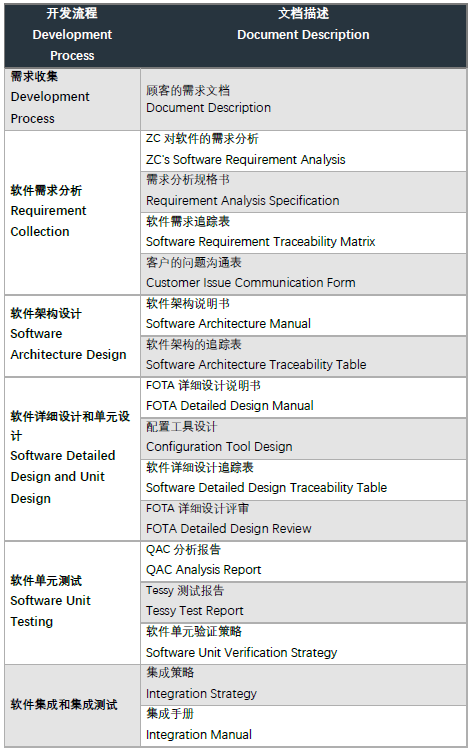
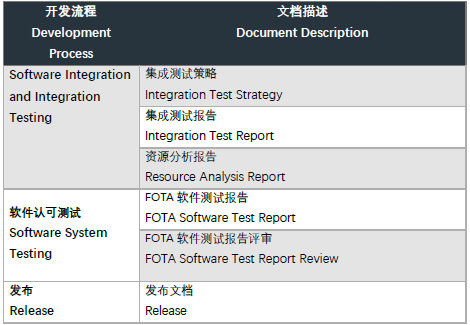
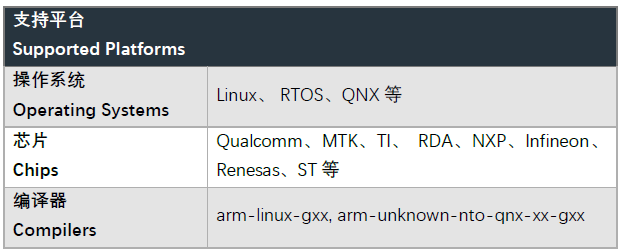
ZC.QingLong FOTA is a program update software (BootLoader) independently developed by ZC. Using the controller of ZC.Qinglong FOTA, the update function of applications and operating systems can be achieved through TCP/IP. Currently, ZC.Qinglong FOTA supports multiple operating systems such as LINUX, RTOS, QNX, and complies with the program update specifications of many vehicle manufacturers, offering customized development services.
ZC.Qinglong FOTA has already supported the program update specifications of many mainstream vehicle manufacturers.
ZC.Qinglong FOTA can be applied to the controller program update function in multiple domains of a vehicle. The supported controllers include::
Ø Body System
Body controller, air conditioning controller, door controller, gateway, etc.
Ø Power System
Power System Engine controller, battery management system, motor controller, vehicle controller, etc.
Ø Chassis System
Electric power steering system, anti-lock braking system, electronic stability system, etc.
Ø ADAS System
Radar, camera systems, etc.

FOTA System Architecture
ZC.Qinglong FOTA software operates on top of the OS of the SoC, utilizing the Flash management capabilities provided by the OS, assisting device components and the TCP/IP protocol stack to provide application upgrade capabilities for the upper-layer APP.
The ZC.Qinglong FOTA software includes the following functional modules:
Ø Network Adaptation Layer for SoAd
It implements the mapping relationship between I-PDU ID and Socket, converting PDU communication into Socket communication.
Ø Diagnostic Interface for DoIP
It handles diagnostic communication and network management functions, responsible for data transmission.
Ø Diagnostic Communication Management DCM
It implements the complete UDS protocol, responsible for process control.
Ø FOTA Handler
Responsible for application installation, application verification, and rollback operations in case of errors.
Ø Security Management Algorithm SecM
It implements security algorithms, responsible for data security and access control.

Click to download the product manual